
Text vs. Email for Fundraising: Why the Channel Decides Your Reach

Text vs. Email for Fundraising: Why the Channel Decides Your Reach

The short answer: the channel you ask through decides how many people ever see the ask — and being seen is most of the battle. Texts get opened around 98% of the time; fundraising emails, closer to 20%. Same family list, several times the eyes. A text-first campaign puts each participant’s ask in front of far more of their network, which is why it raises more per person.

Based on general marketing open-rate data and GroupFund’s analysis of $60M+ raised across 8,000+ school and youth fundraisers.

Reach is half of every fundraiser

Your total comes down to a simple chain: how many participants share × how many of their people see the ask × how easily those people can give. The middle link — reach — is where most fundraisers quietly lose money, and reach is decided almost entirely by channel.

You can have a fully-participating roster and a great cause, but if the ask lands in an inbox nobody opens, it never had a chance. Getting the message seen is the whole game, and that’s a channel decision.

The open-rate gap

Across marketing data, the numbers aren’t close:

  • Text messages: opened roughly 98% of the time, usually within minutes.
  • Email: opened around 20% for typical promotional and fundraising sends — and the other 80% sit unread next to coupons and newsletters, or never leave the promotions tab at all.

Put that in fundraising terms: send the same ask to the same families, and a text reaches almost all of them while an email reaches a handful. You didn’t change your supporters or your cause — just the channel — and you multiplied your reach.

Why email leaks so badly

Email was built for a different job. Fundraising emails compete with every newsletter, receipt, and promotion in a crowded inbox; they get filtered into tabs, caught by spam, or buried before anyone scrolls. Even a supporter who wants to give often never sees the message, or sees it days late — after the first-week momentum has already passed. In a campaign where 62% of donations land in the first seven days, a channel that’s slow and easily missed costs you the most valuable window you have.

Why text fits how fundraisers actually spread

Fundraisers move through personal networks, and personal networks live on text. A text feels like a message from a person, not a blast from an organization — so it gets opened, and it gets forwarded. A participant shares a link in five seconds; a supporter forwards it to a sibling; it ripples outward the way a fundraiser is supposed to.

And text closes the loop on the other half of per-participant results — ease. A tap on a link, a tap to pay with Apple Pay or Google Pay, done. No account, no card number, no friction between seeing the ask and giving. High reach plus low friction is exactly the combination that raises more per supporter.

Does email have any role?

Yes — just not as the primary ask. Email is fine for longer updates, end-of-campaign recaps, and thank-you notes, where length matters more than open rate. The mistake is making it the channel you raise on. As the engine of the ask, it badly underperforms text; as a supporting update channel, it’s perfectly useful.

What this means for your campaign

If you’re deciding how to run your next fundraiser, choose text-first. It isn’t a small optimization — reach is a primary driver of the total, and channel is the biggest lever on reach. The same roster, the same cause, and the same effort produce a much bigger result simply because more people see the ask and giving takes one tap. (It’s also part of why a donation drive out-raises a product sale: both reach further when they travel by text.)

GroupFund runs entirely on text — every participant shares by text, every supporter gives in one tap — built and guided by former coaches, with no up-front cost. Request a free demo.


FAQ

Is text or email better for fundraising?

Text, clearly. Texts are opened around 98% of the time versus roughly 20% for fundraising email, so a text-first campaign reaches several times more supporters per participant.

What’s the open rate for fundraising texts vs. emails?

Texts are opened about 98% of the time, usually within minutes; typical fundraising and promotional emails closer to 20%. That gap is the difference between an ask being seen and being missed.

Why do fundraising emails underperform?

They compete with every other message in a crowded inbox, get filtered into tabs or spam, and are often seen late or not at all — so they miss the first-week window when most donations come in.

Should I still use email for my fundraiser?

For long updates, recaps, and thank-yous, yes. Just don’t make it your primary ask channel — text reaches far more supporters and makes giving a single tap.

Source: General marketing open-rate data and GroupFund’s analysis of $60M+ raised across 8,000+ school and youth fundraisers.

Donation Drives vs. Selling Products: Which Raises More?

Donation Drives vs. Selling Products: Which Raises More?

The short answer: a donation drive almost always sends more money to your program for less work. Product fundraisers — popcorn, cookie dough, discount cards, spirit wear — can post an impressive gross, but a large share goes to the product and the vendor, so your take-home is a fraction of the total. They also cap your reach at who you can sell to in person and add real logistics. A donation drive keeps nearly everything raised and travels through personal networks by text. Based on GroupFund’s analysis of $60M+ raised across 8,000+ school and youth fundraisers.
Two ways to fundraise

Almost every school fundraiser is one of two models:
  • Product sales — your group sells something (popcorn, cookie dough, candles, discount cards, spirit wear) and keeps the margin after the vendor takes their cut.
  • Donation drives — your group asks supporters to give directly, usually by sharing a link with family and friends. There’s nothing to buy or deliver; the full gift goes to the cause minus only standard processing.
They sound similar at the cash register. They look very different by the time the money reaches your program.

Where the money actually goes

The number that matters isn’t your gross — it’s your take-home: what’s left for uniforms, the trip, the equipment. And that’s where product sales quietly lose.
Selling products Donation drive
What you keep A fraction — vendor and product take a large cut Nearly all of it (minus standard processing)
Reach Whoever you can sell to in person Anyone, anywhere — it travels by text
Effort Order forms, inventory, distribution, collection Share a link; supporters give in one tap
Left to do after Hand out product, chase payments Nothing
When a product drive reports a big number, remember that a chunk of it never reaches your program — it pays for the product and the company behind it. A donation drive starts and ends with your supporters and your cause.

Why donation drives reach further

A product sale is limited by physics: someone has to carry the catalog around, and you can only sell to people you (or your athletes) can reach face to face. That’s a small, local circle. A donation drive isn’t bound that way. Because it’s a link shared by text, it rides through each participant’s entire network — the grandparent three states away, the aunt who never misses a game, the family friend who moved last year. Fundraisers spread through personal networks, and a shareable link reaches all of them; a box of popcorn reaches only the neighbors. (It’s also why the channel you ask through matters so much.)

Effort and logistics

This is the hidden cost of product fundraisers. Someone has to place the bulk order, track who sold what, store the inventory, distribute it, and chase down unpaid forms. That’s weeks of volunteer time — and every hour of friction is an hour participation quietly drops, because busy people abandon complicated tasks. A donation drive removes all of it. Participants share a link; supporters tap to give. There’s no product to receive, no cash to collect by hand, nothing to hand back out. The effort goes into asking — the part that actually raises money.

When a product drive still makes sense

To be fair, product sales aren’t worthless. They can build community, they give younger kids a tangible thing to sell, and a beloved annual sale (the band’s citrus drive, the team’s calendar) can be part of a program’s identity. If your group genuinely enjoys it and the tradition matters, keep it. Just go in clear-eyed: treat it as a community event with a fundraising bonus, not as your main engine — and don’t be surprised when the take-home lands far below the gross.

The bottom line

If the goal is to put the most money toward your program with the least work, a donation drive wins on all three axes that matter: take-home, reach, and effort. Sell products for the tradition; run a donation drive for the result. (Not sure which theme to pick? Start with what actually works.) GroupFund is a text-first donation platform — built and guided by former coaches, with no product to push and no up-front cost. Request a free demo.

FAQ

Do donation fundraisers raise more than selling products?
For take-home, almost always. Product fundraisers lose a large share to the product and vendor and cap your reach at who you can sell to in person, while a donation drive keeps nearly everything and travels through personal networks.
How much of a product fundraiser goes to the cause?
Only the margin left after the vendor’s cut — your take-home is a fraction of the gross. A donation drive, by contrast, sends the full gift to the cause minus only standard processing.
Are product fundraisers ever worth it?
Sometimes — for tradition, community, or giving young kids something tangible to sell. Just treat them as a community event with a fundraising bonus, not your primary engine.
What’s the easiest type of fundraiser to run?
A donation drive. There’s no inventory, distribution, or collection — participants share a link and supporters give in one tap. Source: GroupFund’s analysis of $60M+ raised across 8,000+ school and youth fundraisers.
School Fundraising Ideas That Actually Work

School Fundraising Ideas That Actually Work

The short answer: the fundraising idea matters far less than most people think. Across 8,000+ campaigns and $60M+ raised, what separates a big result from a disappointing one isn’t whether you chose a car wash, a bake sale, or a donation drive — it’s participation, timing, and a strong first week. The single highest-leverage “idea” is a simple one run well: a text-based donation drive where every participant shares on day one. Based on GroupFund’s analysis of $60M+ raised across 8,000+ school and youth fundraisers.

The uncomfortable truth about “fundraising ideas”

Search “school fundraising ideas” and you’ll get a hundred listicles ranking gimmicks — glow runs, candy bars, restaurant nights, cookie dough. They’re fun to skim, but they answer the wrong question. The idea is the theme of your fundraiser. It is not what determines how much you raise. Our data study found that the same handful of factors decide the total almost regardless of theme: how many participants actually share, how strong the first week is, how long you run, when you launch, and how ambitious your goal is. A brilliant idea executed poorly raises less than a plain one executed well. So before you pick a theme, get the fundamentals right — then the theme is just flavor.

What actually decides your total

Every fundraiser, whatever its theme, lives or dies on the same levers: Pick any idea below, run it on those fundamentals, and it works. Skip them, and the cleverest idea on the internet still flops.

So which ideas actually work?

Themes fall into a few broad families, and they’re not equal — mostly because of how much they leak to overhead and how far they can reach.

Donation drives (the highest-leverage option)

A direct, donation-based drive — every participant shares a link with their family and friends — consistently does the most for the least work. There’s no product to buy, store, or deliver, so nearly everything raised stays with the program. And because it travels by text through personal networks, it reaches supporters anywhere, not just people you can physically sell to. This is the format built to win on participation and reach. Selling a product can work, and the gross can look impressive — but a meaningful share goes to the product and its vendor, so your take-home is a fraction of the total. They also add real logistics: inventory, order forms, distribution. They build community and suit some groups, but they cap your reach at who you can sell to in person. (We compare the two head-to-head in donation drives vs. selling products.)

Events and experiences (car washes, restaurant nights, galas)

Events are great for spirit and visibility, but their ceiling is attendance — you can only raise as much as the room holds, and they’re labor-intensive to pull off. They work best as a complement to a digital drive, not the main engine.

Pledge-a-thons (read-a-thon, jog-a-thon, and friends)

A-thons are a clever hybrid: they bundle an activity with direct asks, which keeps participation high and overhead low. Run with the same text-first, share-on-day-one approach, they perform a lot like a donation drive with a fun hook on top.

How to make any idea punch above its weight

Whatever theme you choose, the playbook is identical:
  1. Get every participant sharing on day one — participation, not the theme, sets your ceiling.
  2. Load contacts before launch so the first 72 hours are explosive.
  3. Run it on text, so the ask actually gets seen and giving is one tap.
  4. Keep it to 15–21 days and launch into your back-to-school or pre-season window.
  5. Set an ambitious goalbold targets hit more often than timid ones.

Match the idea to your program

  • Big rosters (band, booster, football) win on volume — a donation drive that activates all 100+ members beats any boutique event.
  • Small, tight teams win on depth — personal, text-based asks to close networks out-raise a bake sale every time.
The theme can be whatever fires up your group. The engine underneath should always be the same. GroupFund runs that engine for you — a text-first donation drive, built and guided by former coaches, with no up-front cost. Request a free demo.

FAQ

What is the best school fundraising idea?
A text-based donation drive run on the fundamentals — full participation, a strong first week, and the right timing. In GroupFund’s data, how a fundraiser is run matters far more than its theme.
Do fundraising ideas actually matter?
Less than most people expect. The same factors — participation, first-week momentum, timing, length, and channel — decide the total across almost every theme. A simple idea run well beats a clever one run poorly.
What’s the easiest fundraiser to run?
A donation drive, by a wide margin. There’s no product to buy, store, or deliver and no event to staff — participants just share a link, and supporters give in one tap.
Do you keep more from a donation drive or from selling products?
A donation drive. Product fundraisers lose a meaningful share to the product and vendor, so your take-home is a fraction of the gross. See donation drives vs. selling products. Source: GroupFund’s analysis of $60M+ raised across 8,000+ school and youth fundraisers.
How Long Should a School Fundraiser Run?

How Long Should a School Fundraiser Run?

The short answer: 15 to 21 days. Across 8,000+ campaigns, the two-to-three-week window raised the most — and campaigns that ran a month or longer actually raised less. More time doesn’t mean more money. It means less urgency.

Based on GroupFund’s analysis of $60M+ raised.

Campaign length How it compares to the peak
≤ 14 days ~15% below peak
15–21 days peak — raises the most
22–30 days ~5% below peak
30+ days ~17% below peak

Why longer actually raises less

It’s natural to think a longer fundraiser gives supporters “more chances to give.” The data says the opposite, and the reason is how giving actually flows. Most of the money — about 62% — arrives in the first seven days, while the campaign is fresh and spreading through personal networks. That wave crests fast. A long runway doesn’t add a second wave; it just pushes the deadline so far out that the urgency driving the first one disappears.

Picture a five-week campaign. By the end of week one, most of the total is already in. Weeks two through five aren’t collecting more — they’re collecting slower, picking up the occasional straggler while the original momentum fades and supporters who meant to give forget to. The finish line is too far away to feel real, so nobody hurries. Stretch a campaign past a month and you don’t expand your reach — you just dilute the urgency that makes people act.

Too short leaves money on the table

The opposite mistake is just as real. A fundraiser under two weeks can cut off the ripple effect before it finishes spreading. Your campaign travels outward in waves: a participant shares it, a parent reshares to a class group, a grandparent forwards it to a sibling. Each hop takes a day or two. Cut the window too short and the outer rings of that network — the people two and three shares removed, who often give generously — never get reached before the deadline hits. You also lose the room to send a mid-campaign reminder, which is where a meaningful share of late gifts come from.

That’s why the sweet spot is a window, not a single number: long enough for the network to fully ripple out, short enough that the deadline never stops feeling close.

How to run the 15–21 day window

Two to three weeks gives you a natural three-act structure:

  • Week 1 — the launch. This is the whole ballgame. Everyone shares on day one, supporters give and reshare in the same motion, and roughly two-thirds of your total lands. Everything before kickoff exists to make these seven days explosive.
  • Week 2 — the reminders. Momentum naturally dips. This is when a nudge to participants who haven’t shared, and a reminder to supporters who meant to give, recaptures the people the first wave missed.
  • Final days — the close. A real, approaching deadline does the work. “Last 48 hours” messages, a visible push toward the goal, and final personal asks pull in the procrastinators who always wait until the end.

Anchor your deadline to something real

A date on a calendar is abstract; a moment is motivating. Tie your end date to something concrete — a big game, a competition, a banquet, the start of the season — so the deadline carries its own meaning. “We close the night before our first game” beats “we close on the 21st.” It gives supporters a reason the timing matters, makes the countdown feel real instead of arbitrary, and pairs the deadline with a strong kickoff so day-one urgency is real on both ends.

Set the window at two to three weeks, anchor the finish to a real event, and count down to it. GroupFund builds your campaign on this timing automatically — sized for momentum, not just duration — with no up-front cost. Request a free demo.


FAQ

How long should a school fundraiser last?

15–21 days is the sweet spot. GroupFund’s data shows that two-to-three-week window raises the most, while campaigns of 30+ days raise less and very short ones cut off the network before it spreads.

Do longer fundraisers raise more money?

No. Campaigns running 30+ days raise less than two-to-three-week campaigns, because most donations come in the first week and long timelines kill the urgency that drives giving.

Can a fundraiser be too short?

Yes. Under two weeks often doesn’t give every participant time to reach their full circle, and leaves no room for a mid-campaign reminder — so the outer layers of each person’s network never get the ask.

Should I extend the deadline if we haven’t hit our goal?

Rarely worth it. Extending signals the deadline wasn’t real and usually adds little. A focused final-push day — fresh asks, a clear “last chance,” a visible goal — almost always does more than tacking on extra days.

When should the fundraiser end?

On or just before a meaningful moment — a game, banquet, or season opener — and ideally heading into a weekend, when supporters have time to give and reshare.

Source: GroupFund’s analysis of $60M+ raised across 8,000+ school and youth fundraisers.

Related reading

The Best Time to Launch a School Fundraiser

The Best Time to Launch a School Fundraiser

The short answer: launch into the back-to-school surge — and ahead of your season, never during it. Across the platform, an August launch raises nearly 2× a June one, and fall is the peak window. But the best month isn’t the same for every group: football and booster clubs explode in August, while spring sports like baseball actually raise the most when they launch in the fall or winter — months before their season starts. Here’s the data, and what it means for your program.

Based on GroupFund’s analysis of $60M+ raised across 8,000+ school and youth fundraisers.

When to launch, by program type

The platform-wide average says “launch in late summer” — but that hides what actually matters: your sport has its own clock. We broke every campaign down by program and launch month, and the peak windows are strikingly different. They line up with one simple rule.

Program Best window to launch
Football August
Booster / Athletics August
Band / Music August–September
Volleyball August (preseason)
Baseball / Softball September–January (ahead of the spring season)
Soccer September–November
Basketball September–November
Track / Cross Country January–February
Cheer / Dance April or late summer

Read down the table and the same rule keeps surfacing: launch into back-to-school energy and ahead of your competitive season, never in the middle of it. Here is what that looks like sport by sport.

Fall sports own late summer

Football is the clearest case in the whole dataset. An August launch raises more than double what the same program pulls in most other months — and moving the kickoff just one month, from August into September, costs the average football campaign a large share of its total. The reason is attention: Friday-night-lights season hasn’t started, the whole town is reconnecting at back-to-school, and supporters give into the anticipation of a new season. Once games begin, attention splinters across the schedule and giving cools.

Booster clubs and athletic departments share that August peak. They’re tied to the start of the school year rather than one team’s calendar, so they ride the back-to-school surge across the entire program — the stretch when families, alumni, and the community are most engaged.

Marching band and music peak across August and September, as the school year and marching season ramp up together. Their audience — parents, grandparents, and a notably loyal alumni base — is most plugged in right as the first performances hit the calendar.

Volleyball does best in its August preseason, just ahead of opening serve. Same logic as football: anticipation out-raises mid-season.

Winter and spring sports should fundraise in the fall

This is the counterintuitive part — and where most programs leave the most on the table.

Baseball and softball raise the most launching between September and January, months before the spring season, and the least waiting for spring itself. Launching ahead of the season can bring in roughly two to three times what the same team raises running mid-season. In spring, attention is split across games; in fall and early winter, the community has room to give.

Basketball and soccer peak from September into November — just ahead of and early in their seasons, close enough to feel the momentum but early enough to beat the mid-season split.

Track and cross country come a little later, peaking in January and February, ahead of the spring calendar. Same rule, shifted to match the season.

The year-round exception: cheer and dance

Cheer and dance are the least seasonal programs on the platform — strong in spring (around April) and again in late summer. They follow tryout and banquet cycles rather than one game schedule, which gives them more than one good window each year. The rule still holds: launch into a moment when your community is already gathering — tryouts, a showcase, a banquet — not in the quiet middle.

The rule behind the numbers

Put it together and it’s simple: don’t fundraise during your season — fundraise into the back-to-school surge and just ahead of it.

Why? Two forces stack up in late summer and early fall. First, engagement: the start of the school year is when families, alumni, and the community are most plugged into their team. Second, anticipation: supporters give more generously before a season, when there’s something to build toward (new gear, the trip to state, a strong start) than during it, when attention is split across games. A spring-sport team that waits for its own season misses the window when its community is most ready to give.

If your season is in the fall, August is your moment. If it’s in the winter or spring, launch in the fall or early winter — well before opening day.

How much is getting the timing right actually worth?

A lot — and it’s free. The gap between the right month and the wrong one is bigger than most coaches expect.

Take football. Move the launch from August to September — just one month, into the start of the season — and the average campaign loses roughly 60% of its total. Baseball shows the same swing in reverse: launching in the fall or winter raises close to three times what the same team pulls in if it waits for its spring season.

You can do everything else right — a strong goal, full participation, a great kickoff — and still leave a big share of the total on the table by running at the wrong time of year. Timing is the cheapest lever you have. Pull it first.

Don’t forget the day of the week

A smaller but real edge sits on top of the month: the day you kick off. Friday and Saturday kickoffs raise roughly a quarter to a third more than a Monday launch. Weekend kickoffs ride into the weekend, when supporters have time to give and reshare; a Monday launch fights for attention against the work-week grind.

Can’t hit your ideal window? Here’s plan B

Life happens, and sometimes the perfect month isn’t an option. The fallback rule is the same: get as close to a back-to-school or pre-season moment as you can, and avoid the two traps. The first trap is launching cold in the dead of summer (June–July), when families are scattered. The second is launching into the middle of your own season, when attention is already split across games. A fall program that misses August still has real momentum in early September; a spring sport is better off starting any time in the fall or early winter than waiting for opening day. When in doubt, move the kickoff earlier, not later — anticipation raises more than mid-season urgency.

Plan it backwards

Pick your kickoff first — ideally a late-summer or pre-season Friday or Saturday, tied to a game, first practice, or team meeting — then count back to line up contacts and a goal. Pair the right timing with a 15–21 day run and a strong first week, and you’ve stacked three of the biggest levers in your favor before a single donation comes in.

GroupFund helps you time and launch the campaign for peak impact — we know the window for your sport, and we run it for you, with no up-front cost. Request a free demo.


FAQ

When is the best time to start a school fundraiser?

August is the strongest month on average — nearly double a June launch — and fall (August–October) is the peak window, per GroupFund’s analysis of $60M+ raised.

When should a football team fundraise?

August, clearly. August football campaigns raise more than double what they do in most other months, because the whole community is engaged right before the season.

When should a baseball or softball team fundraise?

Not in the spring. They raise the most launching between September and January — roughly two to three times what they raise waiting for their spring season. Fundraise ahead of opening day, not during it.

When should a band fundraise?

Late summer into early fall — August and September — as the school year and marching season begin.

What’s the best day of the week to launch a fundraiser?

Friday or Saturday. Weekend kickoffs out-raised Monday launches in GroupFund’s data.

When should you avoid running a fundraiser?

Mid-summer (June) and the deep-winter holidays are the weakest windows — and for any team, the middle of its own competitive season.

Source: GroupFund’s analysis of $60M+ raised across 8,000+ school and youth fundraisers, broken down by program type and launch month.

Related reading

Set a Bigger Goal, Raise More

The short answer: ambitious goals don’t scare donors off — they raise more and hit target more often. Groups that set a $50k+ goal averaged $43,221 raised and were the most likely to reach it. Playing it safe with a small goal correlates with raising less.


Based on GroupFund’s analysis of $60M+ raised.


Goal setAvg. raisedHit or beat goal
$50k+$43,22129%
$25k–50k$23,82125%
$10k–25k$9,34819%
<$10k$3,88419%


Why a bold goal works

A goal isn’t just a number — it’s a signal. A big, specific target tells your team and your supporters that this matters, that the program needs them, and that their gift moves a real needle. Counterintuitively, the groups that aimed highest also hit their goal more often (29% for $50k+ vs 19% for sub-$10k) — because the ambition focused the team and rallied the community.


A timid goal does the opposite. “Help us raise $3,000” reads as low-stakes, and supporters give to match the energy you set.


(A note on the data: bigger programs naturally set bigger goals, so some of this is roster size. But the lesson holds — within your program’s reach, aim at the top of what’s plausible, not the bottom.)


How to set yours

  • Anchor it to a real need people can picture — “new uniforms for all 80 members,” “the trip to state,” not just a round number.
  • Aim high but believable. Stretch past comfortable; stop short of fantasy.
  • Make it visible. A clear goal with a live progress bar gives supporters something to push over the line — and fuels the first-week surge.

GroupFund helps you set a goal that’s ambitious and achievable for your program, based on what teams like yours actually raise. Request a free demo.


FAQ

Does setting a higher fundraising goal raise more money?

Yes. GroupFund’s data shows groups with $50k+ goals averaged $43,221 raised and hit their goal more often than groups with small goals.


How do you set a good fundraising goal?

Anchor it to a concrete need, aim high but believable, and make the goal and progress visible to supporters.


Source: GroupFund’s analysis of $60M+ raised across 8,000+ school and youth fundraisers.

The First 7 Days Decide Your Fundraiser

The short answer: 62% of all donations in a school fundraiser arrive in the first 7 days — and 38% in the first 3. Your campaign isn’t won at the deadline. It’s won at
kickoff. Programs that come out hard on day one raise the most; slow starts almost never recover.


Based on GroupFund’s analysis of $60M+ raised across 8,000+ campaigns.


Why momentum front-loads

A fundraiser spreads through personal networks. When every participant shares on day one, supporters give and reshare while the energy is high — friends tag friends, parents post to class groups, alumni chip in. That wave crests fast. Wait a few days to “ramp up,” and you’re pushing a campaign that’s already gone quiet.

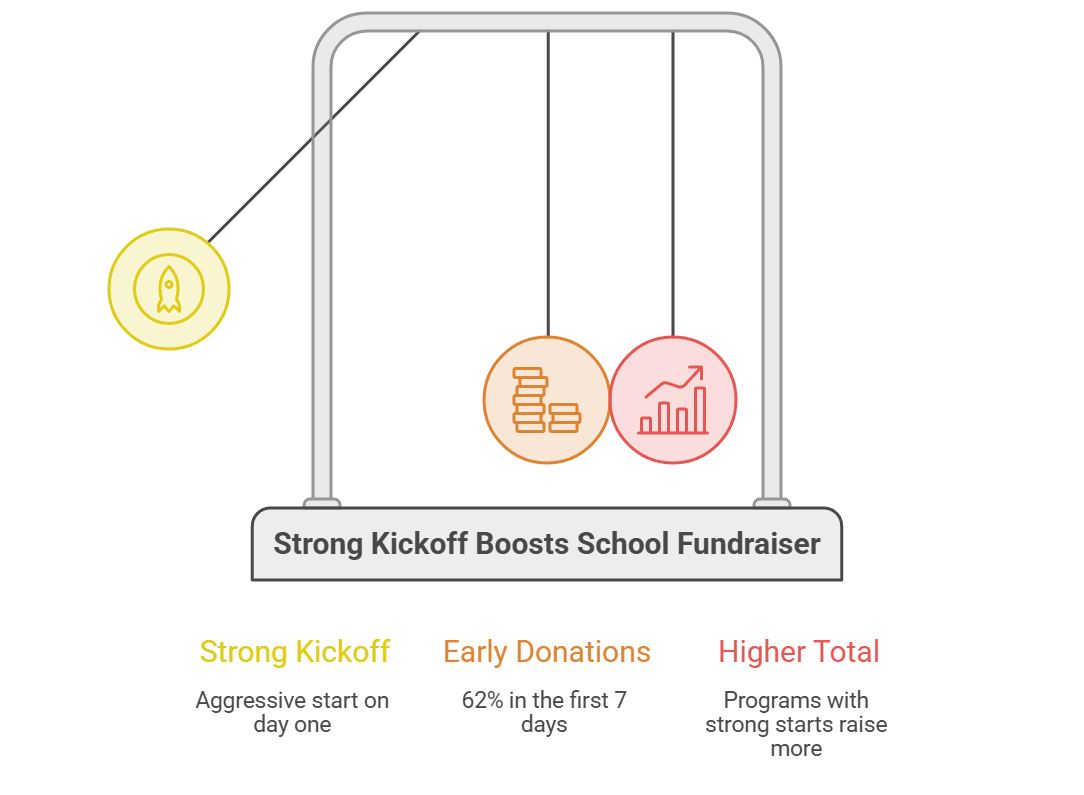
The data is blunt: by the end of week one, nearly two-thirds of the total is already in. The back half of a campaign mostly collects stragglers.


What winning the first week looks like

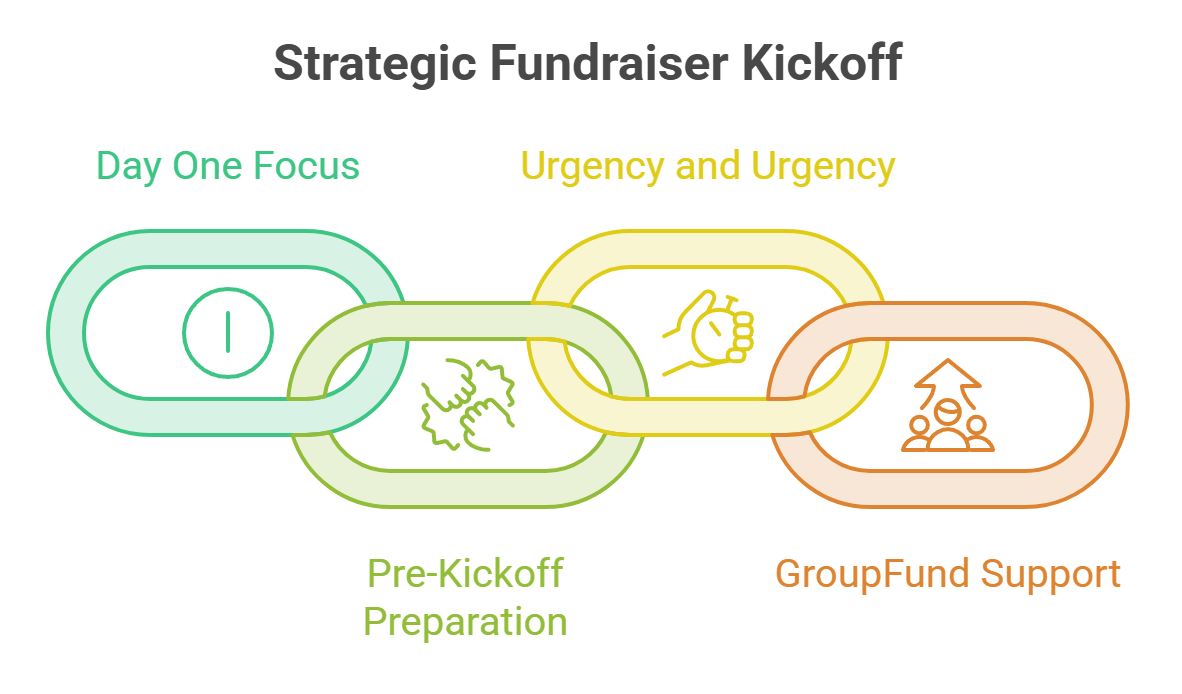
  • Everyone shares on kickoff day — not a trickle over the first week. Participation on day one is the strongest predictor of the total.
  • Load contacts before launch. The campaign should open with supporters ready to be reached, not with students still gathering names.
  • A real kickoff moment — a team meeting, a halftime announcement, a launch text that goes out at once — beats a quiet “the link is live.”
  • Reminders in the first 72 hours, while attention is highest, capture the 38% that lands in the first three days.

What this means for you

Plan your fundraiser backwards from a strong day one, not toward a far-off end date. Everything before kickoff — contacts, goal, team buy-in — exists to make the first 72 hours explosive. (It’s also why a 15–21 day campaign outperforms a month-long one: urgency compounds the early wave.)

GroupFund’s team is built around this — we prep the campaign and coordinate the kickoff so your first week lands hard, with no up-front cost. Request a free demo.


FAQ

How much of a fundraiser is raised in the first week?

About 62% of donations arrive in the first 7 days, and 38% in the first 3, based on GroupFund’s analysis of $60M+ raised.


Why do slow-start fundraisers underperform?

Fundraisers spread through personal networks while energy is high. That wave crests in the first few days, so a delayed start misses most of the reach.


What’s the most important day of a fundraiser?

Kickoff day. Day-one participation is the strongest predictor of the final total.


Source: GroupFund’s analysis of $60M+ raised across 8,000+ school and youth fundraisers.

Big Roster or Tight Team? Two Paths to a Five-Figure Fundraiser

Big Roster or Tight Team? Two Paths to a Five-Figure Fundraiser

The short answer: there are two winning playbooks. Big programs (band, booster, football) raise the biggest totals by activating 100+ participants. Small, tight teams (baseball, volleyball, cheer, basketball) raise the most per athlete on the platform — because close squads tap deeper personal networks. Know which one you are.

Based on GroupFund’s analysis of $60M+ raised.

Program type Typical roster size Per-participant giving
Booster / Athletics ~160 lower
Marching Band ~105 lower
Football ~100 moderate
Cheer / Dance ~40 high
Volleyball ~37 high
Baseball / Softball ~32 highest
Basketball ~32 high

The math behind the two playbooks

Every total comes down to a simple equation: participants who share × how much each one raises. Those two levers pull in opposite directions across program types, which is why there’s no single “right size” for a big fundraiser — just two different ways to win.

Each participant is really a doorway to a network — their family, friends, and neighbors. A big roster opens a lot of doorways, each leading to a modest hallway. A small, tight-knit team opens fewer doorways, but each one leads somewhere deep. Both can clear five figures; they just get there from opposite ends of that equation. The trick is knowing which lever is yours to pull.

If you have a big roster

Your advantage is reach. With 100+ participants — booster clubs, marching bands, football programs — even a modest per-head average compounds into a large total. But that strength has a catch: your whole game rides on participation rate. Every athlete or member who doesn’t share isn’t just one missing gift — it’s an entire network that never hears the ask.

This is exactly how big programs fall short. The total comes in disappointing, and the instinct is to blame the audience or the cause — but the real culprit is almost always that half the roster never activated. A 160-member program running at 50% participation is really an 80-person campaign wearing a big jersey. Your job isn’t to squeeze more out of each supporter; it’s to get every participant to open their doorway. Make sharing a five-second, one-tap action, and the volume does the rest.

If you have a small, tight team

Your advantage is intensity. Small squads — baseball, softball, volleyball, cheer, basketball — raise the most per athlete on the entire platform, because a 25-player team is a tight community whose families and supporters go deep. The networks are smaller but warmer: a grandparent, an aunt, a neighbor who’s watched this kid play for years gives differently than a name on a 200-person list.

You won’t out-total a 150-person booster club, and you don’t need to. The play is full participation plus genuine personal asks. When every athlete truly works their circle — a real message to real people, not a link dropped in a group chat — a small team punches far above its size and clears five figures on the strength of depth, not breadth.

The universal lever: participation rate

Here’s what ties both playbooks together: whether you’re big or small, the number that decides your total is the same — what share of your roster actually shares the campaign. Roster size only sets your ceiling; participation rate determines how close you get to it.

That’s why participation, not headcount, is the number to watch. A 40-athlete team at 100% participation beats a 120-student program limping along at 50% — the smaller team is running at full power while the bigger one leaves more than half its reach on the table. You can’t always change how big your program is. You can almost always change how many of them show up on day one.

So which lever is yours?

  • Big roster (100+): obsess over participation rate. Your total is capped by how many members actually share, so make sharing effortless and chase full activation before anything else.
  • Small, tight team (under ~40): obsess over depth. Per-head giving is your edge, so coach genuine personal asks and aim for every single athlete to reach their inner circle.
  • Either way: participation is the lever. Roster size is the hand you’re dealt; participation rate is how you play it.

GroupFund tailors the campaign to your program — big or small — and drives participation for you, with no up-front cost. Request a free demo.


FAQ

Do bigger teams raise more money?

They raise bigger totals because they have more participants, but small teams raise more per athlete — baseball, volleyball, and cheer lead the platform per head in GroupFund’s data. Both can clear five figures.

How can a small team raise a lot?

Full participation plus genuine personal asks. Small squads have the highest per-participant results on the platform because their networks are smaller but much deeper and warmer.

What matters most — roster size or participation?

Participation rate. Roster size only sets the ceiling; the share of participants who actually share the campaign determines how close you get to it. A fully-participating small team beats a half-participating big one.

Why do big programs sometimes underperform?

Almost always because a large share of the roster never activated. A 160-member program at 50% participation performs like an 80-person one — the missing half takes its whole network with it.

How do I raise participation?

Make sharing fast and frictionless (a one-tap text link), launch everyone at once on day one, and give participants a real reason and reminder to act. Participation is the lever both big and small programs share.

Source: GroupFund’s analysis of $60M+ raised across 8,000+ school and youth fundraisers.

Related reading

What Actually Raises the Most? We Analyzed $60M+ in School Fundraisers

What Actually Raises the Most? We Analyzed $60M+ in School Fundraisers

The short answer: the biggest fundraisers come from high participation, a late-summer launch, a two-to-three-week run, an ambitious goal, and a strong first week. Across 8,000+ real campaigns and $60M+ raised, the programs that win aren’t the ones that work the hardest — they’re the ones that get those five things right. Here’s what the data actually shows, and how to put each one to work.

This is GroupFund’s analysis of more than $60 million raised by school and youth programs on our platform.

What we looked at

These aren’t survey answers or rules of thumb. They come from 8,000+ completed campaigns and over $60 million in real, completed donations across football, band, booster clubs, cheer, baseball, volleyball, basketball, soccer, and more. We looked at how much each program raised, how many participants took part, when they launched, how long they ran, and what goal they set — and the same five patterns show up again and again.


1. Your roster is your engine — and participation is the throttle

The single biggest driver of total dollars raised is how many participants actually share the campaign. Every participant brings their own circle of family and friends, so the math is simple: more people sharing means more supporters reached. But how a program wins depends on its size — and there are two distinct playbooks.

Program type Typical roster size Per-participant giving
Booster / Athletics ~160 lower
Marching Band / Music ~105 lower
Football ~100 moderate
Soccer ~45 moderate
Cheer / Dance ~40 high
Volleyball ~37 high
Baseball / Softball ~32 highest
Basketball ~32 high

Look down that last column and a clear pattern appears:

  • Big-roster programs (booster clubs, band, football) win on volume. Their per-participant numbers are lower, but with 100–160 people each working their own network, the totals add up fast. Their whole game is participation rate — every athlete or member who doesn’t share is an entire network left untapped.
  • Small, tight teams (baseball, volleyball, cheer, basketball) win on intensity. They raise the most per participant on the platform, because close-knit squads tap deeper, more personal networks — each athlete’s circle gives more. A 30-player team will never out-total a 160-person booster club, but it can absolutely clear five figures.

If you take one thing from this whole study, make it this: participation rate beats roster size. A 40-athlete team where everyone shares will out-raise a 120-student program where half the roster sits out. Roster size sets your ceiling; participation rate decides how close you get to it.

2. The first week decides everything

This is the most important — and most overlooked — number in school fundraising:

62% of all donations arrive in the first 7 days. 38% arrive in the first 3.

Fundraisers are won or lost at kickoff, not at the deadline. A campaign spreads through personal networks while the energy is high — supporters give and reshare in the same breath, friends tag friends, parents post to class groups. That wave crests fast. By the end of week one, nearly two-thirds of the total is already in; the back half of a campaign mostly collects stragglers.

The practical takeaway is blunt: the programs that hit big are the ones that come out of the gate hard, with everyone sharing on day one — not the ones hoping for a late surge. A slow start almost never recovers, no matter how long the campaign runs. Everything before kickoff — loading contacts, setting the goal, rallying the team — exists to make those first 72 hours explosive.

3. Two to three weeks is the sweet spot

It’s tempting to run a fundraiser for a month or more to “give people time.” The data says the opposite: longer is not better. Momentum fades, and a deadline that’s too far away kills the urgency that drives giving.

Campaign length How it compares to the peak
≤ 14 days ~15% below peak
15–21 days peak — raises the most
22–30 days ~5% below peak
30+ days ~17% below peak

Run for 15–21 days. It’s long enough for the network to fully activate and for stragglers to come back around, but short enough that the deadline still feels real. Stretch past a month and you don’t gain reach — you just dilute urgency and watch the average slide.

4. Launch in late summer — and ahead of your season

Timing is one of the most powerful — and most underused — levers you have, and it’s completely free. A campaign launched in August raises nearly 2× one launched in June. Back-to-school is the most connected moment of the year: supporters are reconnected, schedules are set, and the season is on the horizon. Fall (August–October) is the peak window; mid-summer and the deep-winter holidays are the weakest.

There’s also a smaller edge most programs miss — the day you kick off. Friday and Saturday launches out-raise a Monday start by roughly a quarter, because weekend kickoffs ride into the days when supporters have time to give and reshare.

But the single best month isn’t the same for everyone. Football and booster clubs explode in August; spring sports like baseball actually raise the most launching in the fall or winter, months ahead of their season rather than during it. The rule that ties it together: launch into back-to-school energy and ahead of your competitive season, never in the middle of it. (We break the best window down sport by sport in The Best Time to Launch a School Fundraiser.)

5. Aim higher than feels comfortable

Ambitious goals don’t scare donors off — counterintuitively, the groups that aim highest raise more and hit their target more often.

Goal set Share that hit or beat their goal
$50k+ 29%
$25k–$50k 25%
$10k–$25k 19%
under $10k 19%

Groups that set the biggest goals weren’t just optimistic — they were the most likely to actually reach them. A bold, specific goal signals that the program matters, focuses the team, and gives supporters a real finish line to rally behind. A timid goal does the reverse: “help us raise $3,000” reads as low-stakes, and people give to match the energy you set. (A note on the data: bigger programs naturally set bigger goals, so some of this is roster size — but within your program’s reach, aim at the top of what’s plausible, not the bottom.)


The five-point checklist

  1. Get everyone sharing — participation rate is the #1 lever, bigger than roster size.
  2. Win the first week — 62% of the money lands in 7 days; nail the kickoff.
  3. Run 15–21 days — not longer.
  4. Launch in late summer / fall, ideally a Friday or Saturday, and ahead of your season.
  5. Set an ambitious goal — bold goals hit more often than safe ones.

Do all five and you’ve stacked every major lever in your favor. GroupFund’s team builds and runs the entire campaign around these dynamics for you — no up-front cost, live in under 30 minutes, and groups keep far more of what they raise than the percentage-based platforms. Request a free demo.


FAQ

What raises the most money for a school program?

Five things together: high participation, a late-summer launch, a 15–21 day run, an ambitious goal, and a strong first week. Across $60M+ in GroupFund campaigns, programs that get all five right raise dramatically more than those that don’t.

What matters more — roster size or participation?

Participation rate. Roster size sets your ceiling, but the share of your team that actually shares the campaign decides how close you get to it. A fully-participating small team beats a half-participating big one.

Do small teams or big programs raise more?

Big programs raise bigger totals (more participants), but small, close-knit teams raise the most per participant — baseball, softball, and volleyball lead the platform — because tight squads tap deeper personal networks. Whichever you are, participation rate is what decides your total.

How much of a fundraiser is raised early?

62% of donations arrive in the first 7 days, and 38% in the first 3 — the kickoff is decisive, not the deadline.

How long should a school fundraiser run?

15–21 days. Shorter limits reach; longer loses momentum and urgency.

When is the best time to start a school fundraiser?

August is the strongest month on average — nearly double a June launch — and fall (August–October) is the peak window. The ideal month also depends on your sport: launch ahead of your season, not during it.

Do ambitious fundraising goals actually work?

Yes. Groups that set the biggest goals hit or beat them more often than groups with small goals — a bold target focuses the team and rallies supporters.

Source: GroupFund’s analysis of $60M+ raised across 8,000+ school and youth fundraisers.

Related reading

Get Started Now Or Request More Info...

Enter your name, phone number, and email below and one of our fundraising experts will be in touch with you soon.

Free-Consultation-Raise-your-funds

Where Do We Send Instant Access?

School-Fund-raise-free-ebook

Where Do We Send Instant Access?

Enter your name, email and phone number below to get our FREE eBook: